How many moving boxes do I need? Counts by home size
Start from a published estimate for your home size, get the mix of sizes right, then adjust for books, kitchens and how much you own. Here is how to do it without running out at 11 p.m.

Nobody runs out of boxes at a convenient time. It happens on the last night, with the kitchen half packed and the stores closed. The fix is not to buy a mountain of cardboard; it is to start from a sensible estimate for your home size, get the mix of sizes right (that's where most counts go wrong), and then adjust for the things that make your home different from the average. These ten tips walk through it. If you haven't decluttered yet, do that first (it's step one of our packing hacks), because every item you get rid of is a box you don't need.
Start from a published estimate for your home size
You need a starting number, and the published estimates broadly agree. Redfin's moving guide gives these ranges:
| Home size | Estimated boxes (Redfin) |
|---|---|
| Studio | 10–20 |
| 1 bedroom | 20–40 |
| 2 bedrooms | 40–60 |
| 3 bedrooms | 60–80 |
| 4 bedrooms | 80–120 |
| 5+ bedrooms | 120+ |
Use the low end if you are a light packer who has just decluttered, the high end if your closets are full. The ranges are wide on purpose: two two-bedroom apartments can hold very different amounts of stuff. The rest of this post is about where in the range you land.
Get the size mix right, not just the total
A total of 60 boxes is useless if they are all large. Box kits from packaging suppliers show the kind of mix that works. Uline's kits, for example, are built like this:
| Uline kit | Small | Medium | Large | Other |
|---|---|---|---|---|
| Apartment, 1–2 bedrooms | — | 20 | 15 | — |
| Small home, 2–4 bedrooms | 25 | 20 | 15 | — |
| Deluxe home, 5–8 bedrooms | 25 | 40 | 30 | 5 wardrobe, 5 dish boxes |
Notice two things. Medium boxes are the workhorse in every kit. And small boxes show up as soon as there is a real household to pack, because small boxes are where heavy things go.
Know what the sizes actually are
"Small" and "large" mean different things at different stores, so check dimensions. U-Haul's box guide lists its standard sizes: a 12 x 12 x 12 inch book box, a small box at about 16 x 12.5 x 12.5 inches, a medium at about 18 x 18 x 16, a large at 18 x 18 x 24 and an extra-large at 24 x 18 x 24. Its guidance on what goes where is the rule to follow: small boxes for small, dense things (tools, small appliances, canned food), mediums for kitchen gear and decor, larges for light but bulky items, extra-larges for pillows, quilts and seasonal clothing.
Count the heavy categories separately
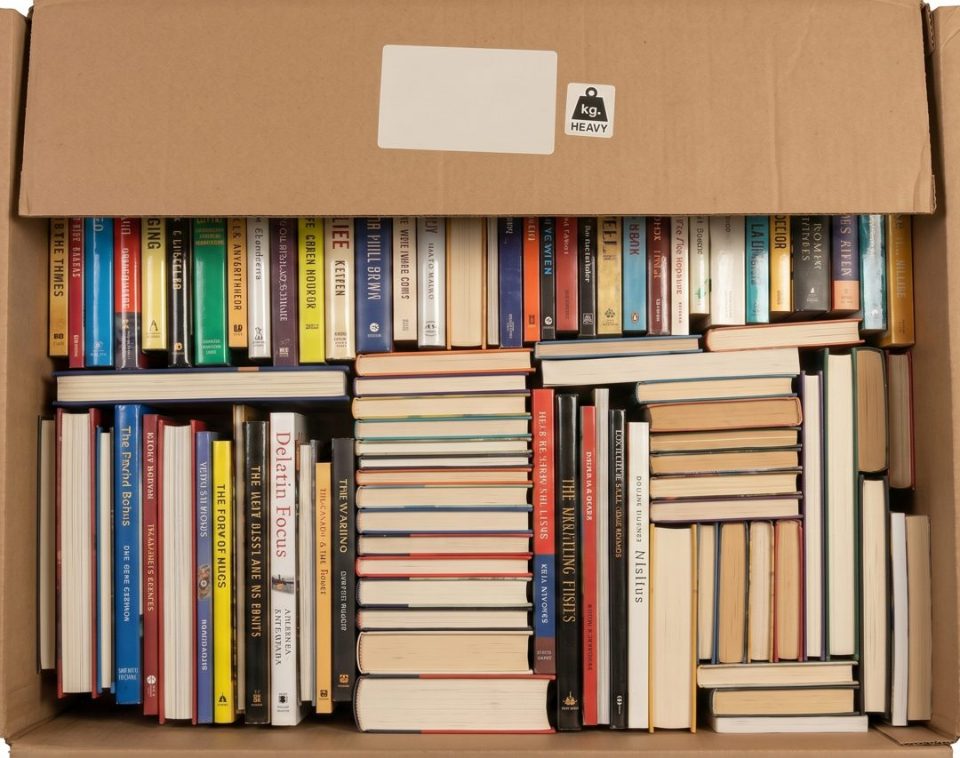
Books, records, files, canned goods, tools and dishes are the categories that blow up a box count, because they can't go in big boxes. A large box of books is a box nobody can lift. The NIOSH lifting guidance puts the maximum two-handed lift under ideal conditions at 51 pounds, and moving is not ideal conditions. So walk your shelves and estimate these separately: a shelf of hardcovers fills roughly one small or book box. Add those boxes to the small column before you buy anything.
The kitchen needs more boxes than any other room
Kitchens are dense, fragile and full of odd shapes, which is why the larger supplier kits add dedicated dish boxes and why dish-packing kits exist at all (U-Haul's Dish Saver, for instance, is a box with a cell divider and foam pouches for plates and glasses). Budget the kitchen on its own: dishes and glasses in dish boxes or mediums with dividers, pots and pans in mediums, the pantry in small boxes. Count the cabinets, not the room.
Don't box what doesn't need a box
Some things travel better without one. Hanging clothes can go in wardrobe boxes (they're in the bigger kits for a reason) rather than being folded into ten mediums. Towels, blankets and linens can do double duty as padding around fragile things, which Atlas Van Lines recommends, so they don't need boxes of their own. Pillows and comforters can go in large bags. Every one of these is a box you don't buy, tape, carry or flatten.
Walk the house room by room before you buy
A whole-house guess hides the closets. Do a five-minute walk with a notepad: each room, each closet, the garage, the attic, under the beds, and the bathroom cabinets. U-Haul's moving supplies calculator asks for exactly this kind of detail (bedrooms, closets, bathrooms and more) because closets and storage spaces are where the surprise boxes live. Write a rough small / medium / large count per space and add it up; compare it to the range in tip 1.
Buy for the first two weeks, then top up
You don't need every box on day one. Packing goes room by room, starting with the things you use least, so buy enough for the first few rooms plus the heavy categories, and top up as you learn your own rate. Redfin's advice is to grab 10 to 15 extra boxes when in doubt, which is a sensible buffer against the last-night run.
Quality beats quantity for heavy and fragile loads
Free boxes are great for linens and pillows. For books, dishes and anything heavy, use boxes that are sturdy and the right size, with the bottom taped properly. Atlas suggests having at least three different sizes on hand, and some corrugated or extra-sturdy boxes for dishware and other fragile items. A failed bottom on the stairs costs more than the box ever saved.
Number them as you go, so the count tracks itself
The moment you start sealing boxes, write a number on each one. It gives you a live count to compare against your estimate ("we're at 38, the kitchen isn't started, buy more mediums"), and on the other end it lets you check that everything arrived. Labeling and numbering is its own small system; start it with box one.
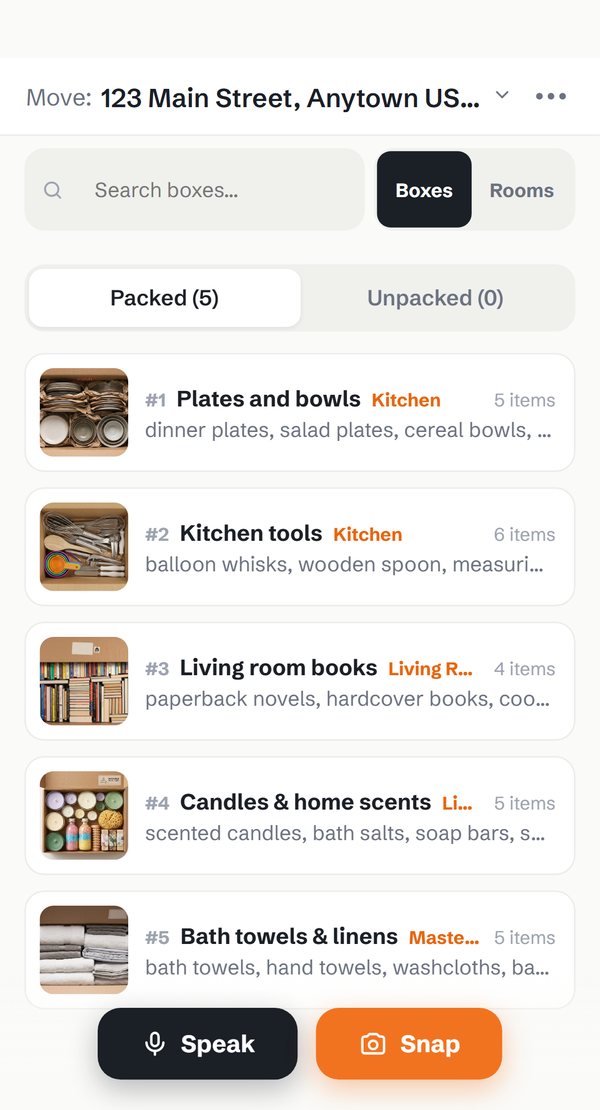
How MoveBuddy helps you plan the box count
- A live count. Numbered boxes with rooms, and a packed tally that grows as you seal them.
- Contents without the label essay. Snap an open box and the AI drafts the item list; you confirm it.
- Boxes by room. See which rooms are done and which still need boxes.
- Find it later. Ask "where are the extension cords?" and get the box number and room.
Free to start on iPhone and Android: your first boxes and AI snaps are on us, and you only pick a move pack when the real packing begins.
The box-count checklist
Print it, stick it on the bin, tick it off. One page.
- Declutter before counting
- Starting estimate for your home size written down
- Walk-through of every room, closet, garage and attic with a rough count
- Heavy categories (books, files, tools, pantry, dishes) counted separately in small boxes
- Kitchen budgeted on its own, with dish boxes or dividers
- Mediums as the default size; larges only for light, bulky items
- Wardrobe boxes for hanging clothes; linens used as padding
- Sturdy boxes for heavy and fragile loads
- First batch bought for the first rooms, topped up as you go
- 10 to 15 spare flat boxes kept until the truck is loaded
- Every box numbered as it's sealed, with a running count
From “How many moving boxes do I need? Counts by home size” — https://movebuddy-ai.com/blog/how-many-moving-boxes-do-i-need · MoveBuddy AI
Questions people ask
How many boxes do I need for a 2-bedroom apartment?
Redfin estimates 40 to 60 boxes for a two-bedroom home. A light packer who has decluttered will be near the low end; a household with lots of books or a full kitchen will be near the top.
How many boxes do I need for a 3-bedroom house?
Redfin's estimate is 60 to 80 boxes, and a 4-bedroom home is 80 to 120. Walk the closets, garage and attic before you trust the number, since that's where houses hide boxes.
What size moving boxes do I need most?
Mediums are the workhorse in nearly every kit. Add small boxes for anything dense (books, tools, canned goods, dishes) and use large and extra-large boxes only for light, bulky things like pillows, bedding and lampshades.
Is it better to have too many or too few moving boxes?
A few too many. Running out stalls packing at the worst moment, while unused flat boxes are easy to give away or store. A buffer of 10 to 15 extra boxes is common advice.
How heavy should a moving box be?
Light enough that you can lift it comfortably. NIOSH puts 51 pounds as the maximum for a two-handed lift under ideal conditions; real moves involve stairs and awkward reaches, so pack heavy items in small boxes and stay well under that.
Sources & further reading
- Redfin, How Many Boxes Do I Need to Move?: estimated box counts by home size, and grabbing 10–15 extra boxes.
- Uline, Apartment Moving Kit, 1 to 2 bedrooms, Small Home Moving Kit, 2 to 4 bedrooms and Deluxe Home Moving Kit, 5 to 8 bedrooms: the box mix in each kit.
- U-Haul, Buying Boxes for Moving: A Complete Guide: standard box dimensions and what to pack in each size.
- U-Haul, Moving Supplies Calculator: estimates supplies from bedrooms, closets, bathrooms and more.
- U-Haul, Dish Saver Packing Kit: a dish box with a cell divider and foam pouches.
- Atlas Van Lines, Packing Tips Guide: heavy items in small boxes, at least three box sizes, towels and linens as padding.
- NIOSH and Cal/OSHA, Ergonomic Guidelines for Manual Material Handling: 51 pounds as the maximum two-handed lift under ideal conditions.
Keep reading
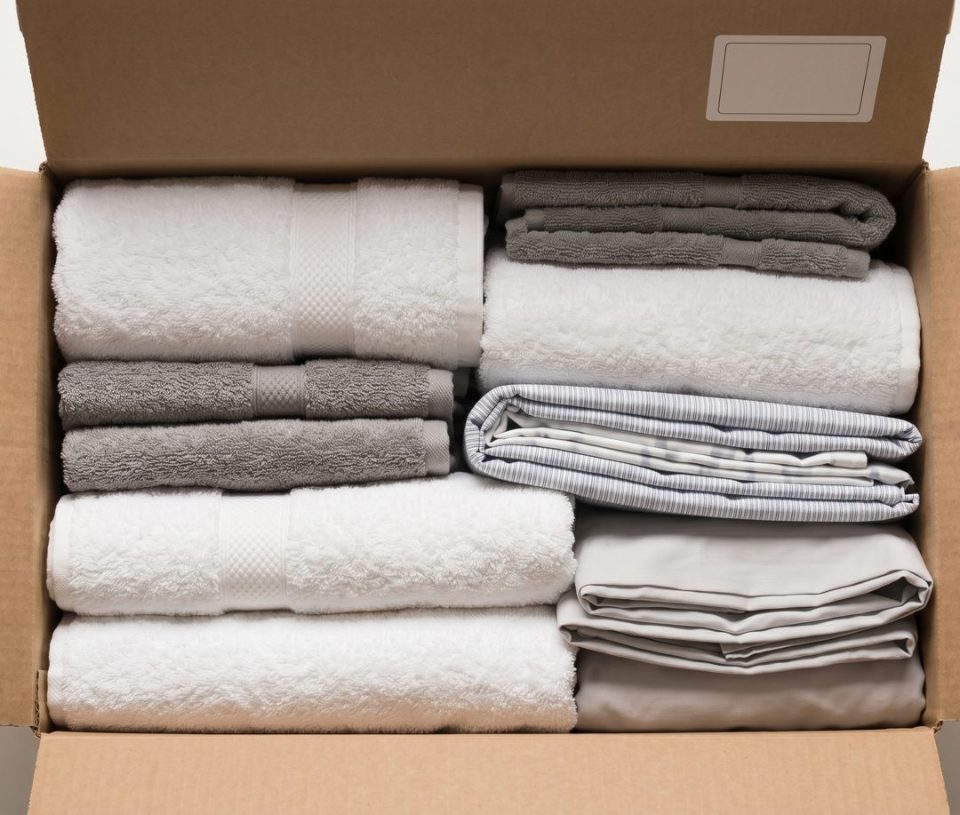
10 packing hacks for moving that actually save time
Not a hundred clever tricks, ten habits that pay off twice: once when you tape the box, and again on the other end when you need something out of it.
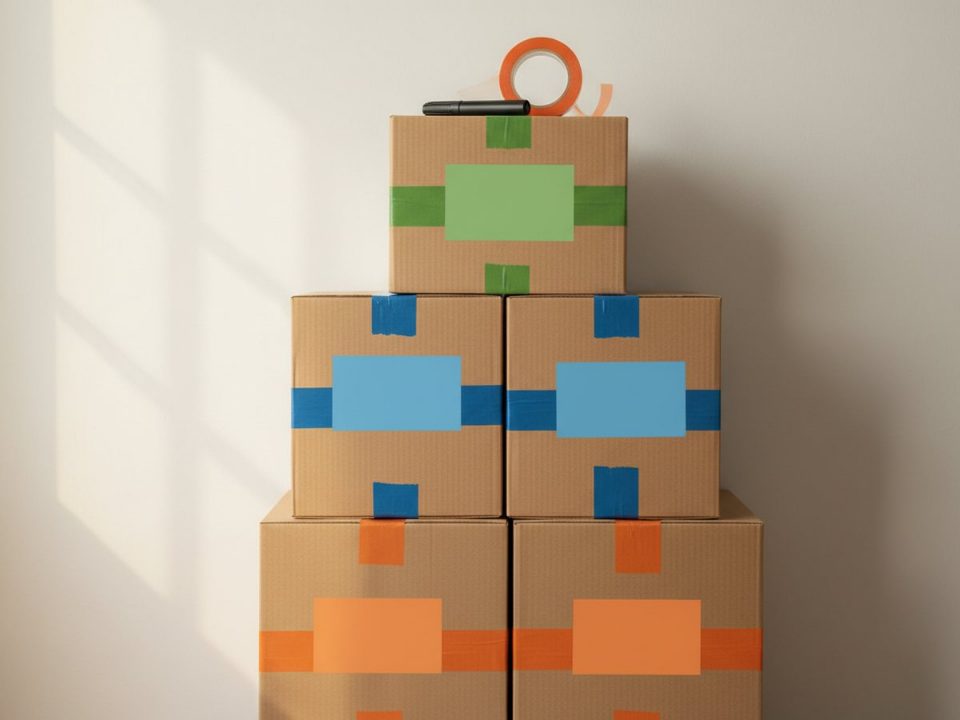
How to label moving boxes so anyone can unload them
A label has two readers: the person carrying the box, who needs a room, and you in three weeks, who need to know what is inside. Write for both.
The 6-week moving checklist that actually works
No 200-item spreadsheet: what matters each week, from booking the truck to the first-night box, plus the one habit that makes unpacking painless.